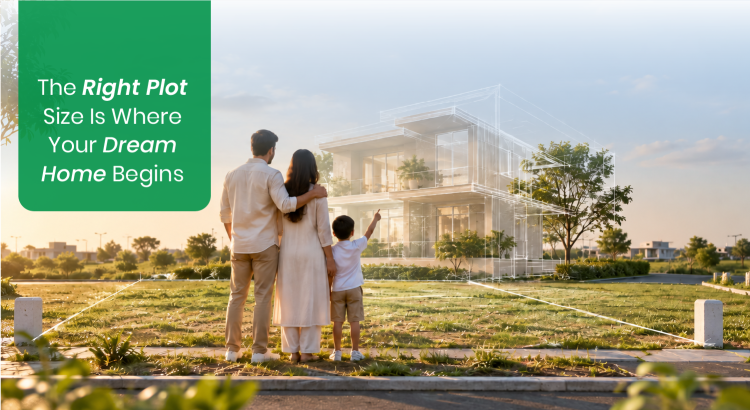
Building a dream home begins long before construction starts. One of the most important decisions is choosing the right plot size. While a larger plot may seem like the obvious choice, the ideal size depends on your family, home design, budget, parking requirements, lifestyle and future.
Why Plot Size Matters More Than You Think
The size of your plot influences much more than the footprint of your house. It affects the number of bedrooms you can plan, parking, open spaces, garden areas, ventilation, privacy and even the possibility of adding another floor in the future.
A well-planned smaller plot can sometimes work better than a larger plot with poor proportions or planning restrictions. The goal is not simply to buy more land, but to buy land that works for the home you want to build.
Factors to Consider Before Choosing a Plot Size
Before finalising a plot, consider:
- Family size: How many bedrooms, bathrooms and common spaces do you need?
- Lifestyle: Do you want a garden, home office, puja room, entertainment area or larger kitchen?
- Parking: Account for the number and type of vehicles you may need to park.
- Plot dimensions: A 30 × 50 ft plot and a 25 × 60 ft plot may have the same area but offer very different design possibilities.
- Future needs: Think about growing children, elderly family members or an additional floor.
- Budget: Remember that your investment includes both land and construction.
- Local regulations: Setbacks, FSI/FAR and other development rules can affect how much of the plot can be built upon.
Standard Plot Sizes in Hyderabad – With Ideal Use Cases
There is no single “perfect” plot size. The right choice depends on your requirements and the applicable development regulations.
- 30 × 40 ft — 1,200 sq. ft. — Compact family home
- 30 × 50 ft — 1,500 sq. ft. — Comfortable 2–3 BHK
- 40 × 50 ft — 2,000 sq. ft. — Spacious family home
- 40 × 60 ft — 2,400 sq. ft. — Larger home with parking/open space
- 50 × 60 ft — 3,000 sq. ft. — Premium home with generous outdoor areas
These are indicative plot configurations, not a substitute for checking the rules applicable to a specific property.
How HMDA/GHMC Setback & FSI Rules Affect Usable Space
One of the biggest mistakes homebuyers make is equating plot area with usable built-up area.
Development regulations can require setbacks from the plot boundaries, along with restrictions relating to building height, road width, coverage, parking and other planning parameters. This means that not every square foot of your plot can necessarily be covered by the building.
For a Hyderabad plot, it is therefore important to verify the applicable HMDA/GHMC regulations and sanctioned development parameters before making a purchase.
The plot’s location, dimensions, abutting road and proposed building configuration can all influence the final design.
Plot Size vs. Number of Floors: G+1, G+2, G+3
A smaller plot does not automatically mean a smaller home. Going vertical can help you maximise your available development potential.
- G+1: Suitable for families wanting a practical two-level home.
- G+2: Can provide additional bedrooms, family spaces or rental accommodation, subject to applicable regulations.
- G+3: Can offer significant additional floor area but requires careful consideration of permissions, structural design, parking and other requirements.
The key is to think about plot area and vertical development together, rather than considering plot size in isolation.
Budget Planning: Land Cost vs. Construction Cost
Your plot budget should not consume the entire homebuilding budget.
Apart from the land purchase, factor in construction, architectural and professional fees, approvals, utilities, interiors, landscaping, compound walls, parking and contingency costs.
A slightly smaller plot in a better location may sometimes make more financial sense than a larger plot that pushes the overall project beyond your comfortable budget.
Think in terms of total project cost, not just the price per square foot of land.
Quick Checklist Before Finalising Plot Size
Before signing on the dotted line, ask:
- Does the plot size match my family’s current and future needs?
- Are the plot dimensions suitable for my preferred home design?
- How many floors do I realistically need?
- What setbacks and development regulations apply?
- How much parking and open space do I need?
- Does the total land + construction budget work for me?
- Have I checked the property’s title, approvals and development permissions?
- Have an architect or qualified professional assessed the plot before purchase?
The Right Plot Is About More Than Size
Choosing a plot is ultimately about finding the right balance between space, design, location, regulations and budget.
The biggest plot isn’t necessarily the best plot. The best plot is one that allows you to create the home you want, within a budget you are comfortable with and under the regulations that apply to the property.
Choose the plot for the life you want to build and for the legacy you want to create for generations to come.